
Medium voltage type test technical insights: Impulse voltage
Cable electrical testing is performed to ensure the integrity of the cable insulation and to identify any defects that may cause electrical breakdown during typical operation. One of the tests used to evaluate the insulation performance of power cables is the impulse voltage test.
The main purpose of the impulse test is to determine the ability of the electrical equipment to withstand voltage surges. These can be caused by circumstances such as lightning strikes, switching operations or even other transient events which can cause voltage surges that can damage the insulation of the electrical equipment and lead to breakdowns and failures.
Impulse testing is commonly used to evaluate the performance of different electrical equipment such as power transformers, circuit breakers, cables, and other medium and high-voltage equipment. The test is an important tool for ensuring the safety and reliability of electrical systems, as voltage surges can cause damage to electrical equipment, disrupt the power supply, and pose a safety hazard to personnel.
The impulse test is designed to simulate these voltage surges and determine if the cable can withstand them without damage. The test is also used to identify any weaknesses in the cable insulation that may need to be addressed before the cable is put into service.
The impulse test is performed in a testing facility of the cable manufacturer or in a third-party laboratory (such as BASEC) by using specialised equipment with high operating and safety technologies.
The testing equipment used for the impulse test includes an impulse generator, a coupling capacitor, and a voltage divider. The impulse generator is used to generate the high-voltage impulse waveform which is a unipolar impulse with a fast rise time and a short duration that is applied to the cable. The coupling capacitor is used to isolate the impulse generator from the cable under test and to ensure that the impulse voltage is applied uniformly to the cable. The voltage divider is used to measure the voltage waveform across the cable during the impulse test.
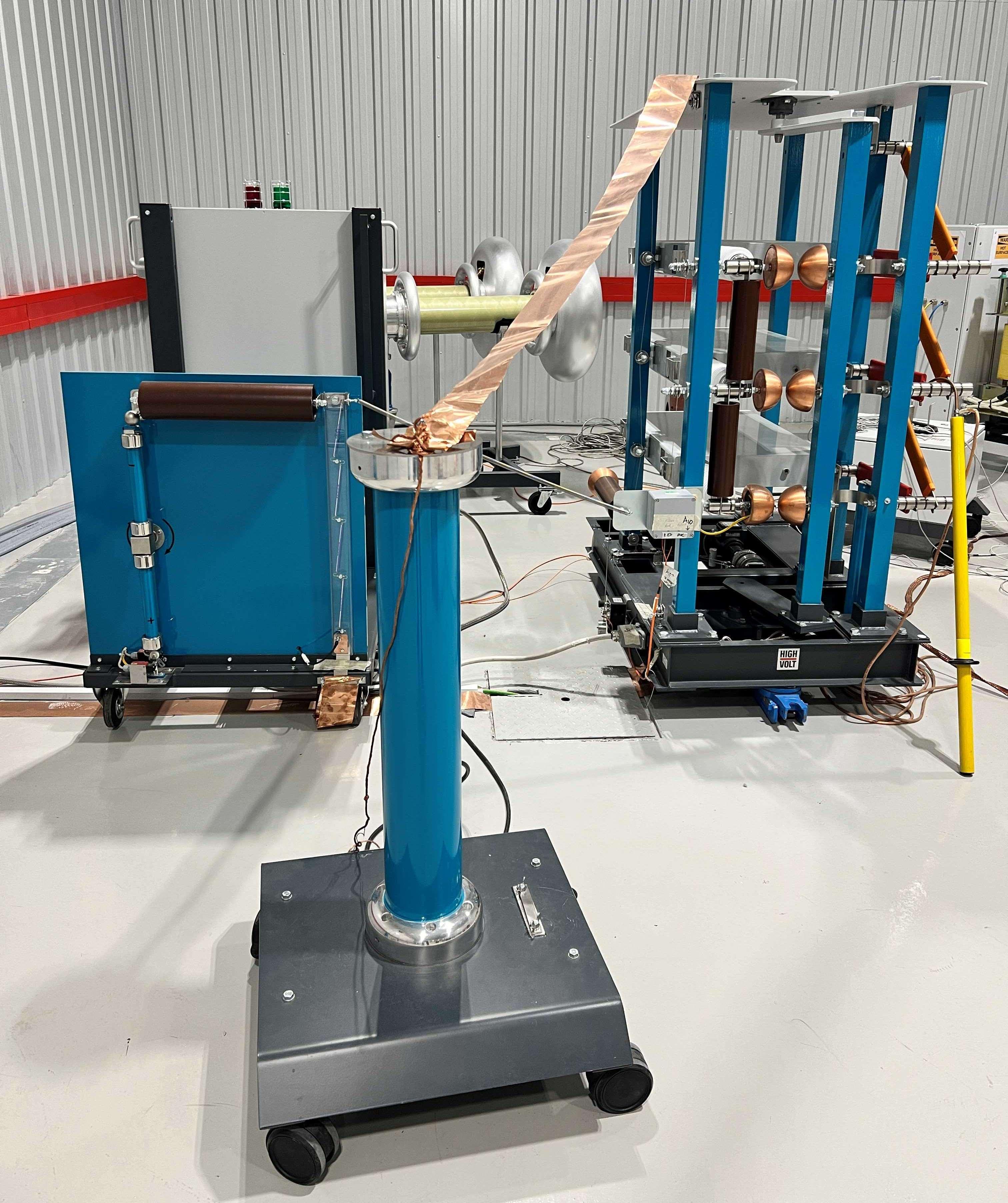
Figure 1: Example of the test equipment
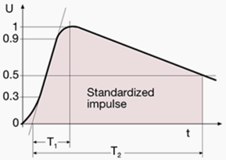
Figure 2: High voltage impulse waveform
Test Criteria
This test is required as part of the electrical sequential test for medium-voltage and high-voltage cables as per different cable standards (IEC, BS, HD, ….etc). There are several industry standards that provide guidelines for impulse testing, for example, but not limited to IEC 60502-2, IEC 60060-1, IEC 60060-2, IEC 60230.. These standards provide detailed procedures for conducting impulse voltage tests, as well as requirements for the peak value of the test voltage and the waveform parameters (i.e. T1, T2).
The test procedure involves the following steps:
- The cable will be heated until the conductor temperature reaches 5 oC to 10 oC above the maximum conductor temperature in typical operation.
- The cable is connected to the impulse voltage generator using a coupling capacitor.
- The impulse voltage waveform is applied to the cable using the impulse generator as per the design standard and the rated voltage of the cable as shown below in table 1 as an example.
- The voltage waveform across the cable is measured using a voltage divider.
- The response of the cable is monitored, and the test results are analysed to determine the ability of the cable to withstand voltage surges.
| Rated voltage U0/U (Um) - kV | 3,6/6 (7,2) | 6/10 (12) | 8,7/15 (17,5) | 12/20 (24) | 18/30 (36) |
| Test voltage (peak) - kV | 60 | 75 | 95 | 125 | 170 |
Table 1 - Impulse voltages (as per IEC 60502-2)
The test is repeated several times, it is not only applying one voltage impulse! Hence the impulse voltage test should be completed by applying 10 positive and 10 negative voltage impulses with the peak voltage to ensure that the cable can withstand voltage surges under different conditions.
Acceptance criteria
To evaluate the performance of the cable against the impulse test to pass or fail, each core of the cable shall withstand without failure 10 positive and 10 negative voltage impulses and after that, each core of the cable shall be subjected to a power frequency voltage test as per the design standards with ‘No breakdown’ of the insulation occurring.
Conclusion
Impulse testing is an essential method for testing medium-voltage and high-voltage cables, it is a part of the electrical type tests for medium-voltage cables and part of sample tests for high-voltage cables. The test is used to determine and ensure the safety and reliability of the cables by assessing their ability to withstand voltage surges. The test procedure involves applying a high-voltage impulse waveform to the cable and analysing the response of the cable to the impulse.
To find out more about medium-voltage cable tests such as impulse voltage and how it can help demonstrate the performance of your cables, contact the team or complete the below enquiry form.